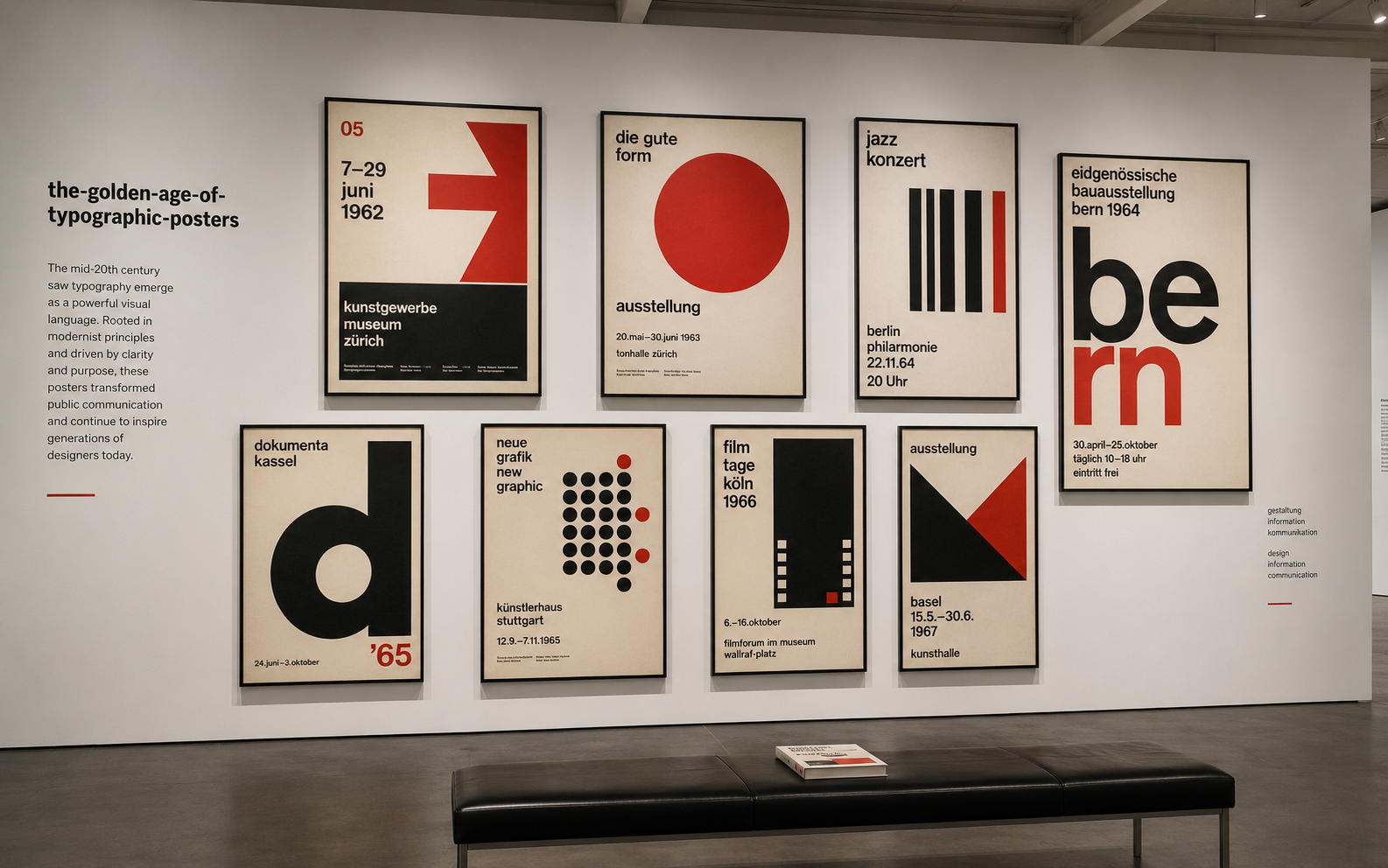

The Bauhaus school operated for just fourteen years, from 1919 to 1933, in three different German cities before political pressure forced its closure. In that short span, it fundamentally altered the trajectory of art, architecture, and design in ways that continue to reverberate more than a century later. For graphic designers in particular, the Bauhaus legacy is not a historical curiosity — it is the foundation upon which much of contemporary practice still rests.
Understanding what the Bauhaus taught — and, equally important, what it got wrong — is essential for any designer who wants to understand why the field looks the way it does today.
Form Follows Function, But Not Blindly
The Bauhaus is most commonly associated with the principle that form should follow function — that the appearance of an object should be determined by its purpose rather than by decorative impulse. In graphic design, this translated into a preference for clean layouts, rational grid systems, asymmetric composition, and the use of sans-serif typefaces that prioritized legibility over ornamentation.
This functional approach produced some of the most enduring graphic design of the twentieth century. The typographic experiments of Herbert Bayer, László Moholy-Nagy, and Joost Schmidt established visual principles — hierarchy through scale, rhythm through repetition, clarity through simplicity — that remain foundational to design education. As the Bauhaus Wikipedia entry has explored in numerous essays, these Bauhaus ideas continue to surface in contemporary design discourse with remarkable regularity.
The Workshop Model
One of the Bauhaus's most influential innovations was its educational model. Rather than separating fine art from applied craft, the school required students to work across both domains. A student might study abstract painting in the morning and bookbinding or typography in the afternoon. This integration of art and craft — of theory and practice — produced graduates who could think conceptually and execute materially.
Contemporary design education still draws heavily on this model, even when it does not acknowledge the debt explicitly. The emphasis on learning by making, on iterating through physical prototypes, on breaking down barriers between disciplines — all of this traces back to the Bauhaus workshop.
The Grid as Liberation
The Bauhaus contribution to graphic design that has perhaps the most daily impact is the development of the typographic grid. While the Bauhaus designers did not invent the grid — that credit belongs more to the later Swiss designers who codified it — they laid the conceptual groundwork by insisting that layout should follow systematic, repeatable principles rather than individual intuition alone.
The grid is sometimes misunderstood as a constraint, a rigid structure that limits creative expression. But the Bauhaus understanding of systematic design was more nuanced. The grid provides a framework within which variation and surprise are possible precisely because there is an underlying order to push against. Without the grid, there is only chaos. With the grid, there is a structure that makes intentional rule-breaking meaningful.
What They Got Wrong
No design movement is without its blind spots, and the Bauhaus had significant ones. Its utopian belief that rational design could solve social problems now reads as naive. Its commitment to universality — the idea that good design transcends cultural context — has been rightly challenged by designers from non-Western traditions who point out that "universal" often meant "European." And its rigid rejection of ornament and decoration, while productive as a polemic, overlooked the genuine human need for beauty that serves no function beyond pleasure.
These critiques do not diminish the Bauhaus legacy so much as complicate it. The school's greatest contribution was not any specific style or technique but a way of thinking about design — as a discipline that can be taught, systematized, and applied to improve the quality of everyday life. That idea, however imperfectly realized, remains as relevant as ever.